
PROJECT
My team and I were interested in looking at post-secondary student’s note-taking experiences, how they are developed and if there are any pain points impacting the stability of these practices. We wanted to determine how we can enhance the experience and develop design recommendations to help designers design a better solution. Over the course of 4 months, 3 other researchers and I conducted semi-structured interviews and diary studies to better understand our users and developed 7 design recommendations.
I was responsible for crafting the interview questions and performing the data analysis for the diary studies in this project.
INFO
Contributions
UX Research, Data Analysis, Writing Report (Lead UX Researcher)
Timeline
Sept-December 2021
Team
Linda Shum, Yijing Wang, Amy Li, & Cloris Tang
OVERVIEW
PROBLEM
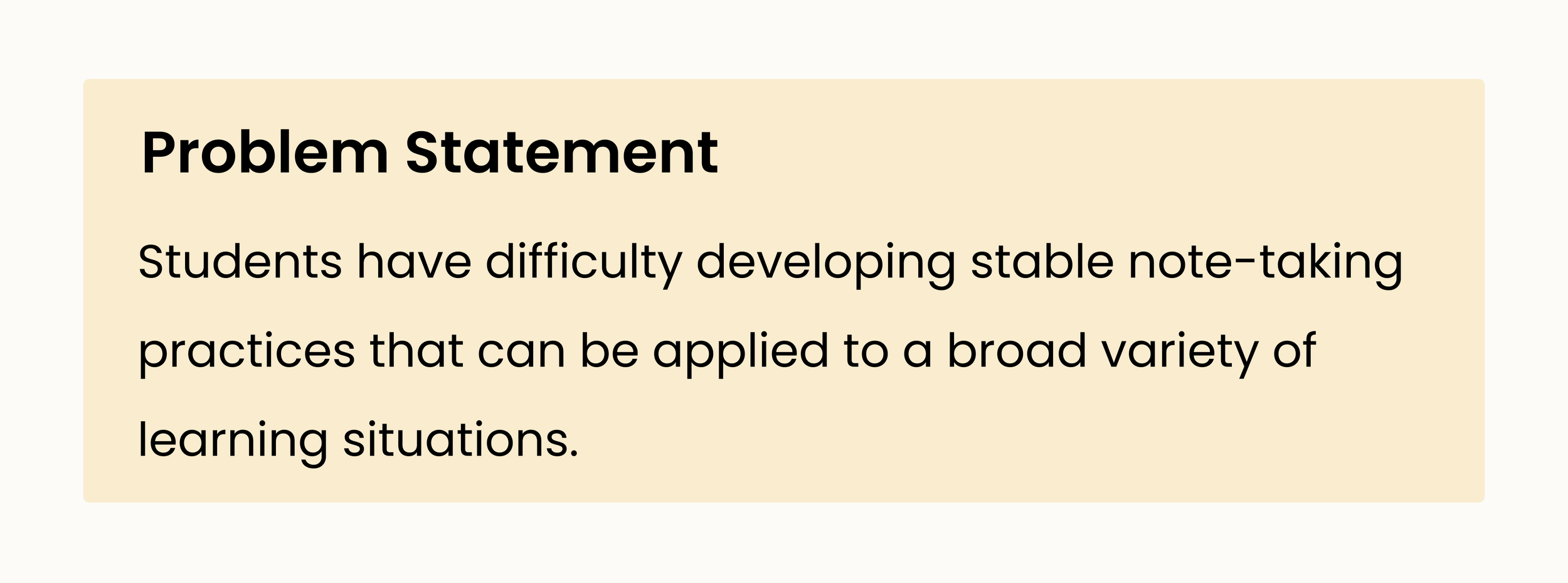
How can we help post-secondary students develop stable note-taking practices that can be applied to a broad variety of learning situations?
GOALS
1. Understand how post-secondary students develop their
note-taking practices.
2. Understand what their current note-
taking practices are.
3. Understand if and how their current note-taking practices have changed.
IMPACT
Developing design recommendations that if implemented, can help to enhance the note taking experience for post-secondary students and encouraging the practice of note-taking.
OUTCOMES:
1) POSTER
A summarized version of this case study in the format of a poster!
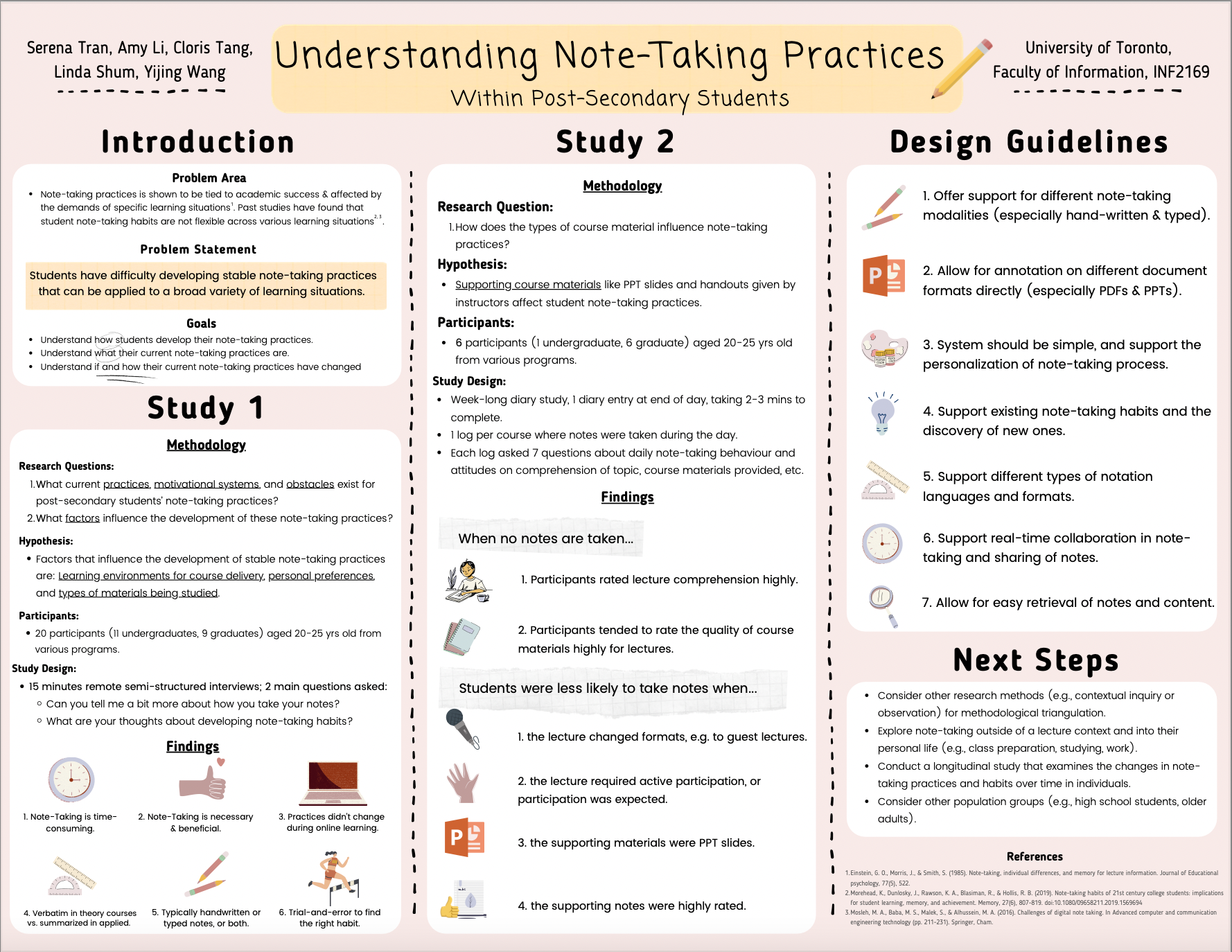
2) VIDEO
A quick 3 minute video that recaps the research methods used, results, and design recommendations.

Secondary Data
Looking at existing literature on post-secondary note-taking practices and experiences, we found:
Many studies support the significance of note-taking activities, with those taking notes during class tending to be more academically successful than those who do not.
Students develop specific note-taking habits based on demands of specific learning situations that aren’t as flexible across the situations
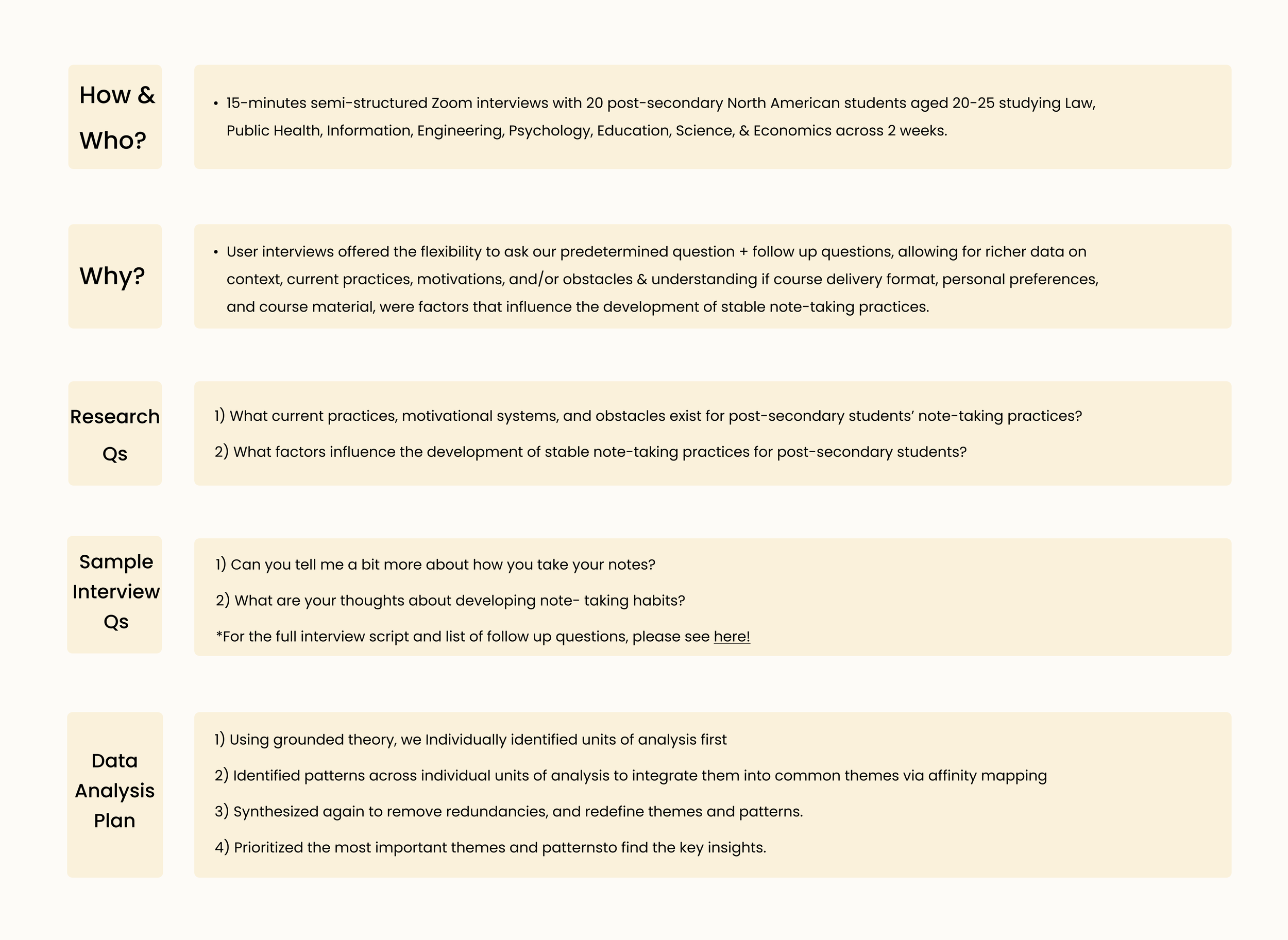
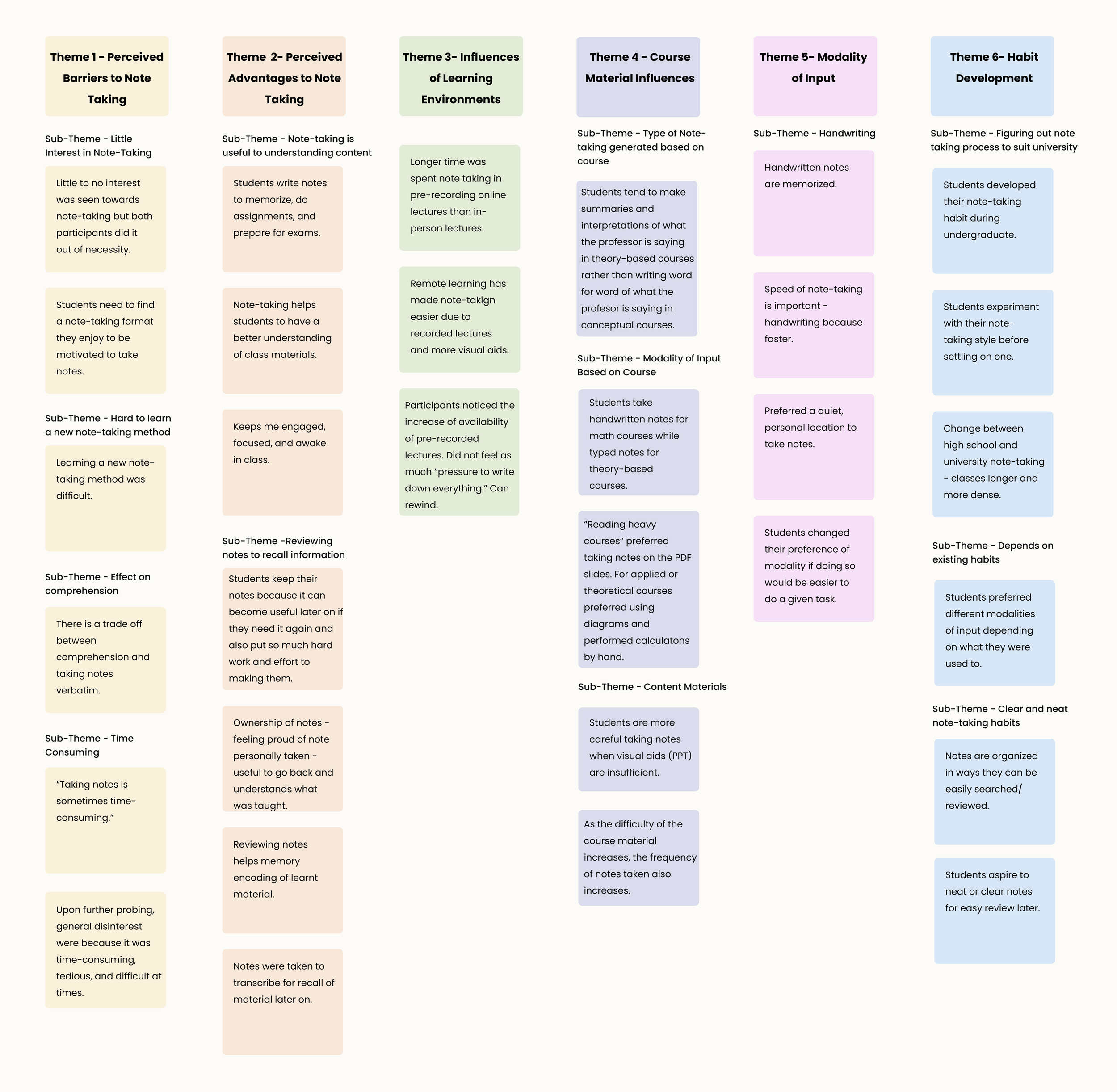
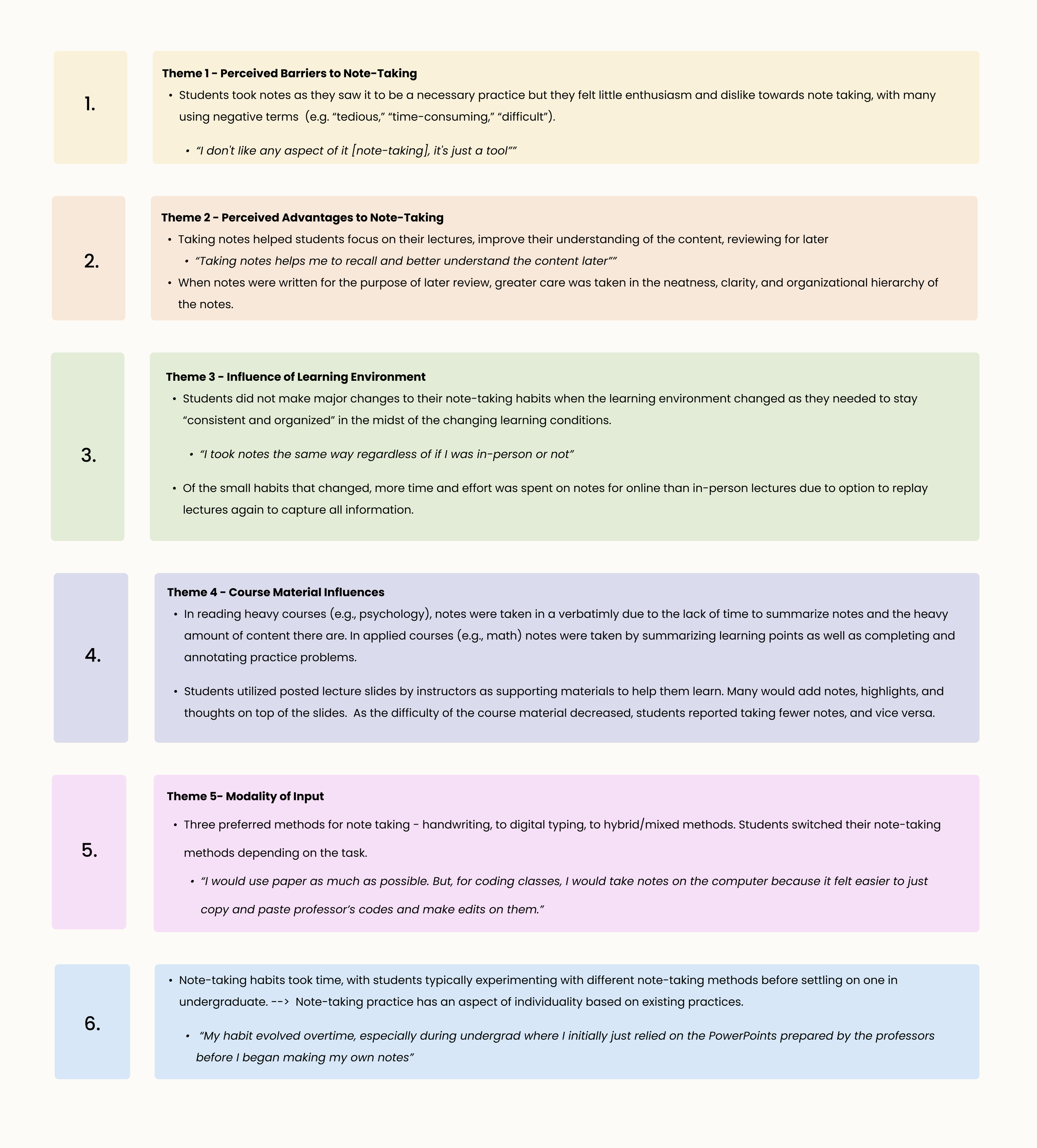
Key Themes from Affinity Diagram
Primary Research (Diary Studies)
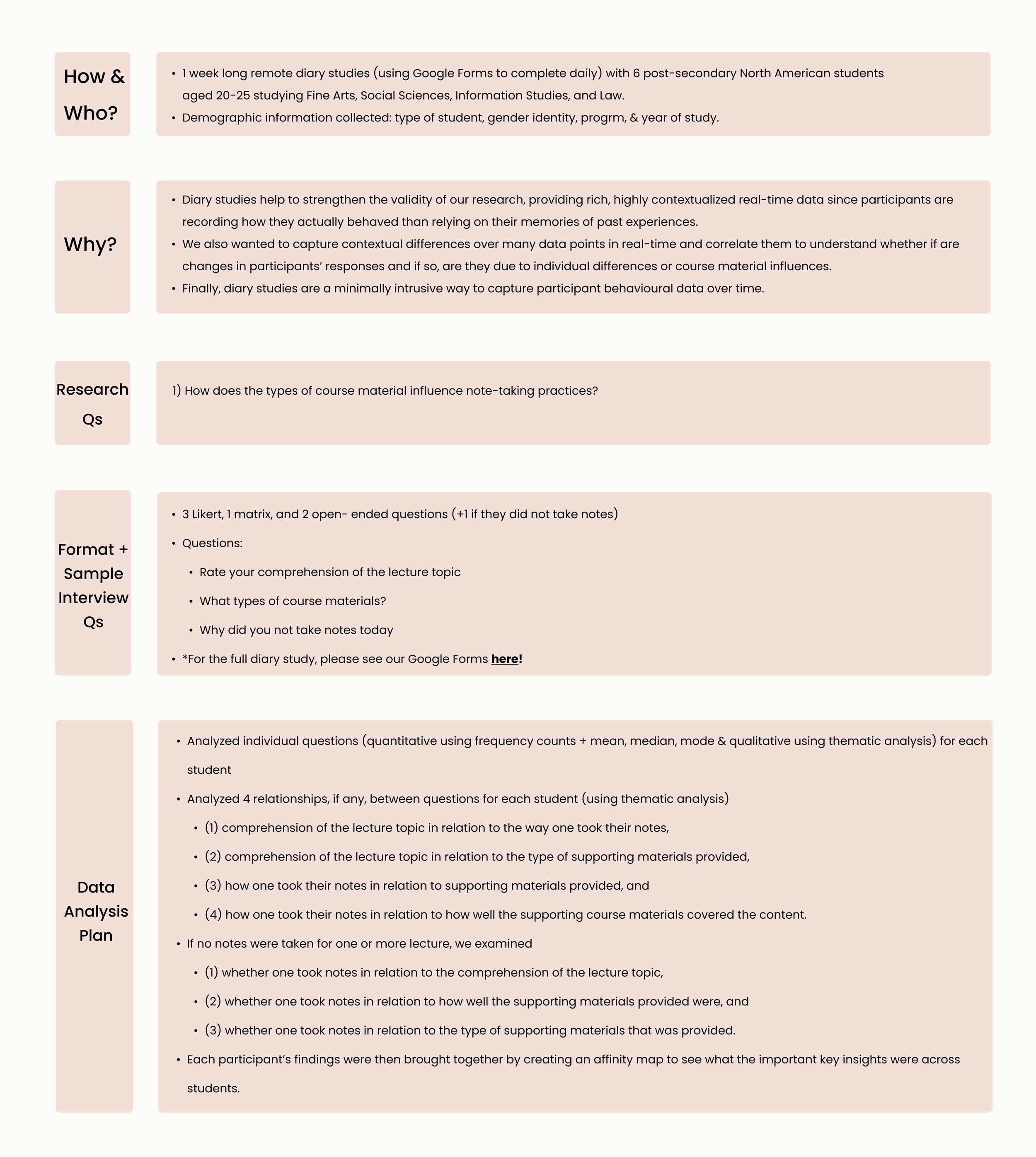
To further investigate about the development and stability of note-taking practices to create our design recommendations, we conducted diary studies to look at the influences of course material on note-taking. What we know so far:
Little is known in the literature about the relationship between course material and note-taking practices.
Studies have shown that students were less inclined to take notes when detailed slides were available (Einstein et al., 1985; Stacy & Cain, 2015).
Other studies have shown that students' academic performance increases when they’re provided with guided notes (,Iannone & Miller, 2019; Larwin & Larwin, 2013).
*For the full diary study, please see our Google Forms here!
Key Themes from Affinity Diagram
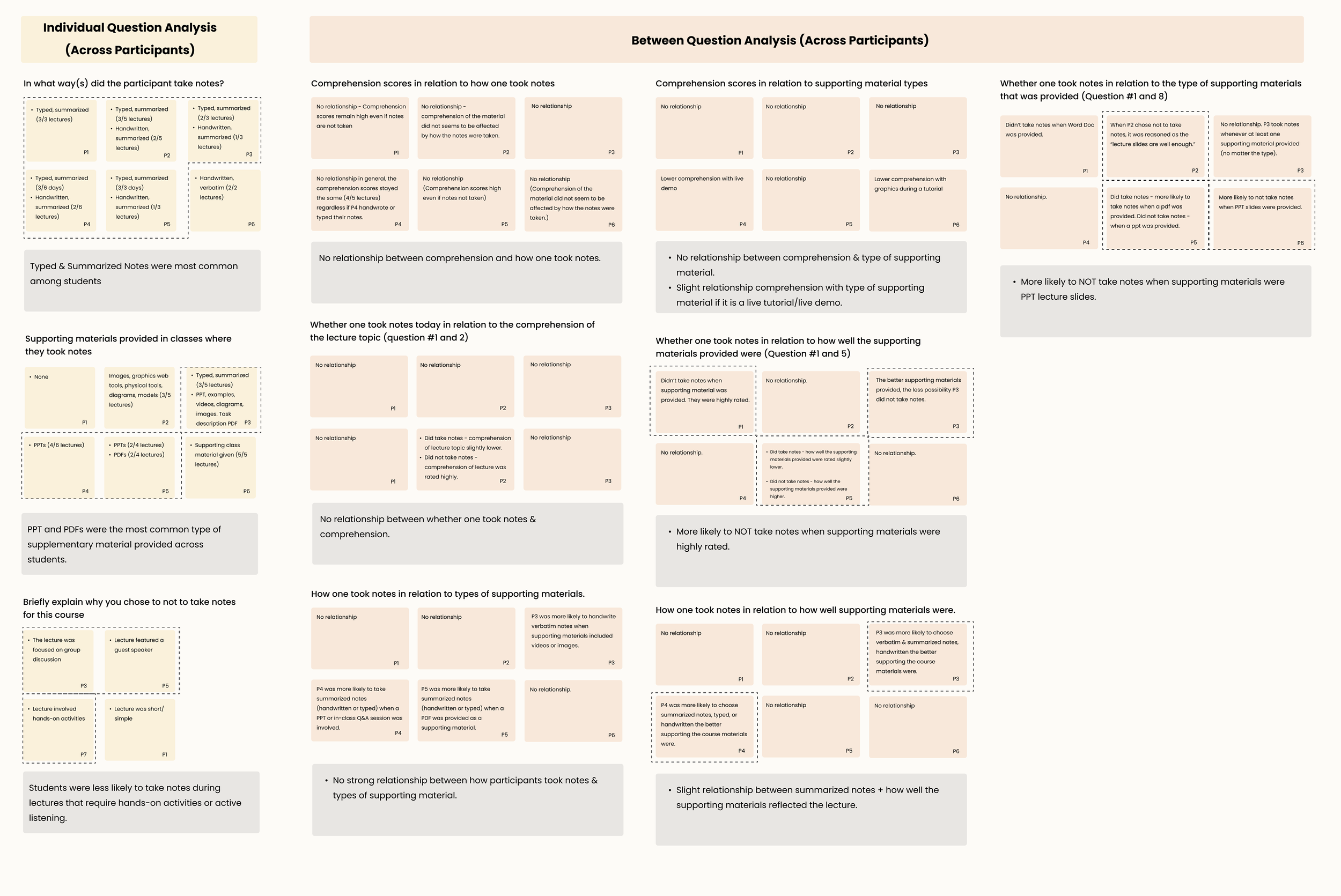
Key Insights from Affinity Diagram

CONCLUSION:
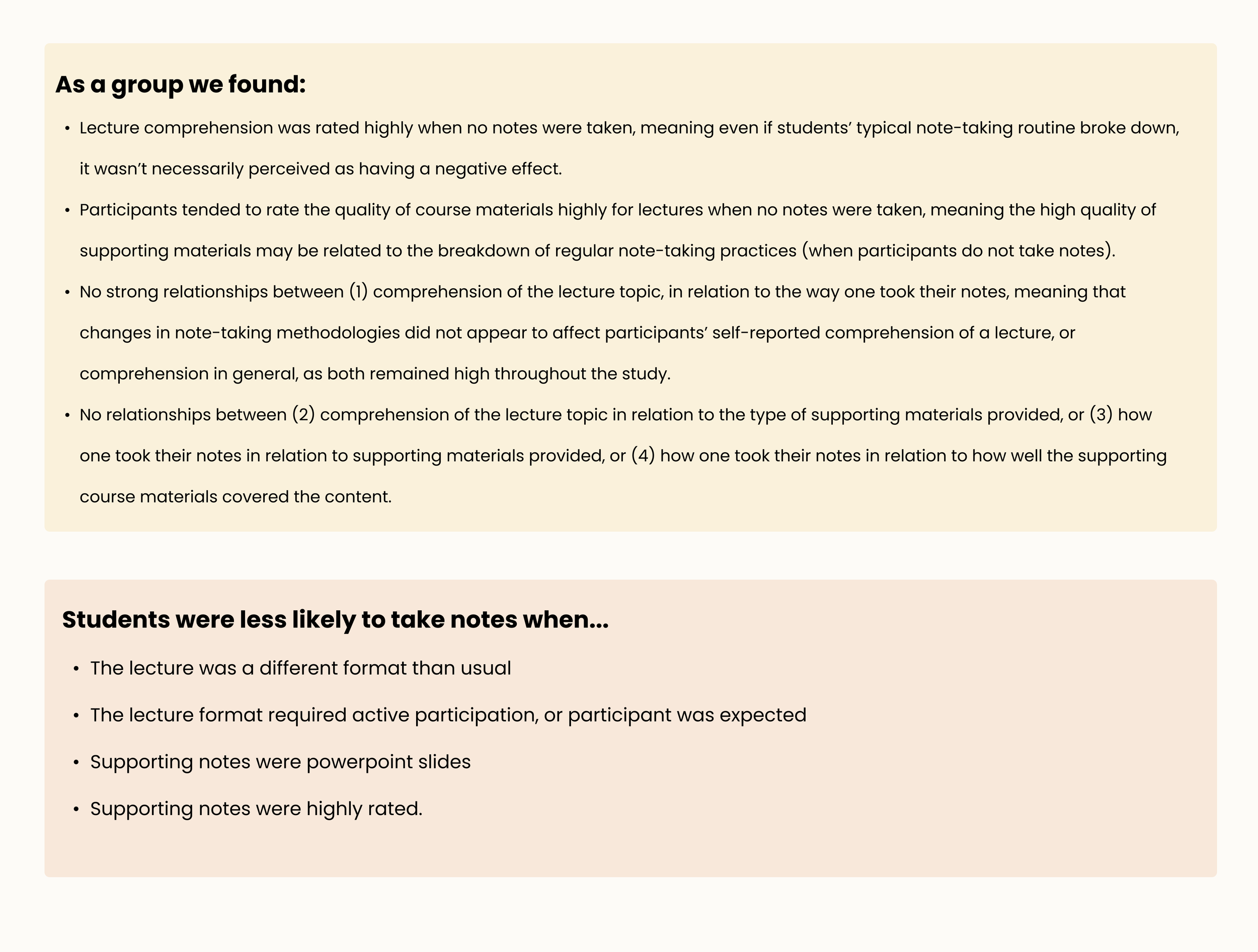
Students did not take notes when excellent supporting course materials existed, indicating that note-taking behaviour is moderately influenced by the quality and the type of course materials already provided.
If PowerPoint (PPT) lecture slides were provided as supplementary materials, participants were less likely to take notes. Hands-on lectures and presentation-based lectures where PowerPoint presentations are offered are likely to require active listening or participation, and therefore note-taking tasks are deprioritized.
Even when our students’ typical note-taking routine broke down (where they did not take notes), it was not necessarily perceived as having a negative effect as their comprehension scores remained high.
Design Recommendations
From the results of the two studies, we offer seven design guidelines to better help support students’ note-taking habits and improve their note-taking experiences.
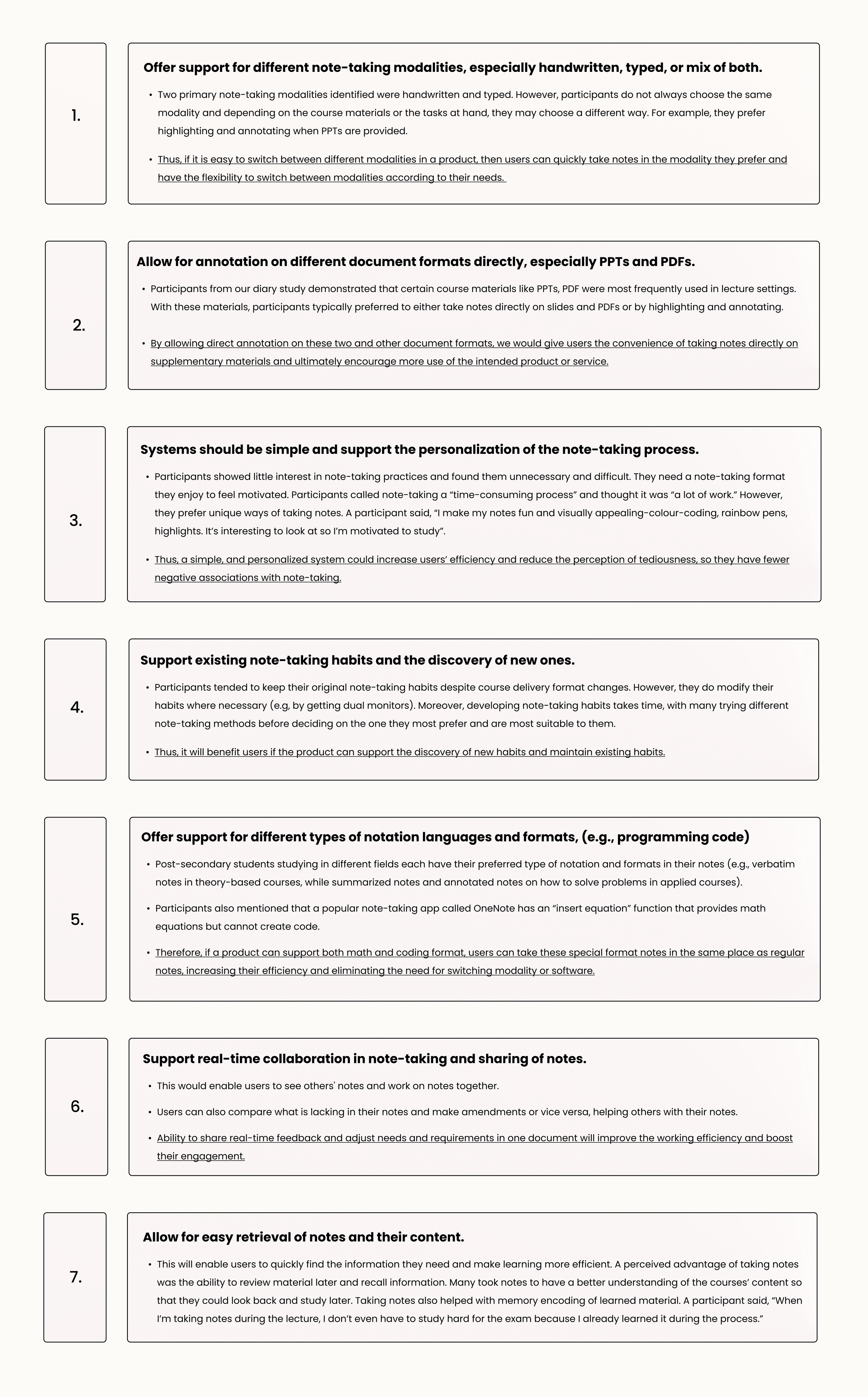

Next Steps
Using other methods like contextual inquiry or observation to see how students take their notes as they complete their note-taking tasks.
Exploring note-taking outside of a lecture context and into their personal life as well as note-taking when studying.
Conducting a longitudinal study that examines the changes in note-taking practices and habits over time may also be of interest to examine the stability of note-taking practices that are developed.
Considering other population groups in addition to post-secondary students to examine if and how findings differ between different groups.
Project Reflections
💡 1) Don't underestimate the power of secondary (desk) research.
This project made me realize that secondary research data can be incredibly helpful in building the foundational understanding and background information to the domain and problem space that I want to learn more about. It allows me to obtain a holistic picture and this can help in determining and guiding the project scope.
💡 2) Being aware of my own biases.
I also learned to not let my own biases or assumptions get in the way of writing interview questions. I noticed that when I was initially writing interview questions, I would phrase it in such a way that implied a certain direction. In giving myself plenty of time to write the questions and to come back to it, I caught that mistake that I did early on and rewrote my interview questions so that it remained as neutral as possible.
💡 3) Writing good interview questions is not easy and takes time.
From this project and from analyzing the raw data, I learned about the importance in asking questions that really added value to what I wanted to learn rather than asking questions just to fill up space. I learned to really ask myself what is the purpose of each question that I am creating and asking myself whether this question will actually provide meaningful data. Rather than just simply creating interview questions for the sake of asking them, I learned to ask questions that are actually important and meaningful because both mine and the interviewee’s time are precious.
Thank you for reading! :)